

Why are high-end fasteners so expensive? With many years of experience, let's talk about the selection logic for stainless steel fasteners.
People often ask me: "They're all bolts — so why does one cost a few cents, while another sells for tens or even hundreds of dollars, and sometimes you have to wait for imports?"
Having worked in the fastener industry for over a decade, I'd like to talk this through seriously.
1. First, Understand the Words "Performance Grade"
Ordinary people look at a bolt and see only its length and thickness. An engineer, however, looks first at its performance grade. China's national standard GB/T 3098.1 classifies bolts into performance grades such as 4.8, 8.8, 10.9, and 12.9 — the numbers represent the tensile strength and the yield-to-tensile ratio.* For example, a Grade 8.8 bolt means a tensile strength of about 800 MPa and a yield strength of about 640 MPa.
But a performance grade is only the "passing line." What truly sets products apart is the material.
Ordinary carbon-steel Grade 8.8 bolts are cheap and produced in huge volumes — perfectly fine for construction and general machinery. But once the operating conditions turn to high temperature, high humidity, or strong corrosion, carbon steel can't hold up, and you need to switch to stainless steel fasteners.* Even within "stainless steel," the differences between A2-70,* A2-80, A4-70, and A4-80 are significant: A2 is the 304 series, while A4 is the 316 series with stronger resistance to chloride-ion corrosion; the numbers 70 and 80 after them indicate the tensile strength class.
Going further up the ladder, there are also duplex steels 2205/2507,* 17-4PH, A286,* as well as the superalloy GH4169 (equivalent to INCONEL 718), Hastelloy C276,* and titanium alloys. There are hundreds of material grades. Bolts made to the same specification can differ enormously in both cost and performance depending on the material.
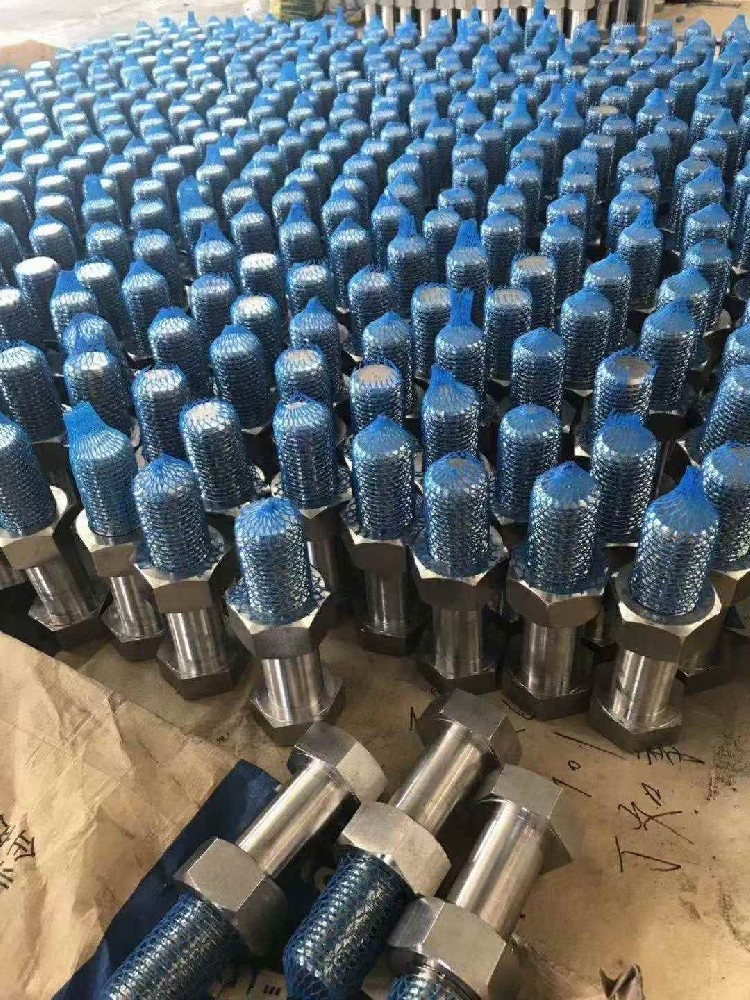
2. What Exactly Makes High-End Fasteners Difficult
Many people think fasteners are "simple parts." In reality, all the hard parts are invisible.
First, the material. Special alloys aren't usable straight off the shelf. The process parameters for forging, heat treatment, and thread rolling are entirely different. Get one step wrong and the part may look identical on the surface, yet its internal properties are already ruined.
Second, standards and traceability. Nuclear power, chemical, and offshore engineering projects often require supply in accordance with standards such as GB, ASTM, ASME, and JIS, and demand batch traceability — the composition of every batch of material and its heat-treatment records must be archived.
Third, non-standard customization. Bolts for wind-turbine towers can be over a meter long; semiconductor equipment calls for micro fasteners that are non-magnetic, non-shedding, and meet strict cleanliness requirements after electropolishing. None of these are off-the-shelf items.
3. The Pitfalls Buyers Fall Into Most Easily
I've seen many project owners come to purchase with a request for "Grade 8.8 stainless steel." Here's a reminder: 8.8 is a performance-grade system for carbon steel; stainless steel is normally designated by A2/A4 plus a number. Forcing the carbon-steel grade concept onto stainless steel makes it easy to end up buying something that doesn't meet the required performance.
So don't choose on price alone — ask three things clearly: What is the material grade? Which standard is applied? How is the performance grade marked?
Fasteners are small, yet they are the "invisible skeleton" of equipment. Choose right, and the equipment stands rock-solid; choose wrong, and a single bolt can bring an entire project to a halt. Spending a bit more care on selection never costs you.