

Building adjustable top braces and base braces are widely used in construction sites, especially in formwork support systems. Scaffolding construction is closely related to the personal safety of construction workers. All construction operations must comply with relevant specifications and be carried out in strict accordance with standard operating procedures.
Building top braces are used in cooperation with steel pipes and scaffolding during construction. They function to adjust the height of scaffolding and pipe frames, balance and bear heavy loads. These components are most commonly applied in concrete pouring construction of flat structures. With the rapid development of the real estate industry and three-dimensional transportation infrastructure in recent years, the demand for building top braces has increased dramatically. They are mainly applicable to beam and slab formwork support in building construction, basement roof formwork support, cast-in-place bridge support, tunnel support and other scenarios. As essential fine-tuning load-bearing components in the formwork support system, they can accurately level the frame structure, disperse the concentrated load generated by concrete pouring, and effectively prevent common construction problems such as formwork deformation, formwork expansion and settlement cracking.
According to the screw rod materials, building top braces are divided into hollow top braces and solid top braces. The screw rods of hollow top braces are made of thick-walled steel pipes, featuring light weight and flexible expansion, which are suitable for ordinary load support of conventional floors. Solid top braces are manufactured from round steel bars with high density and compressive strength, which are not easy to bend and deform. They are widely used in high formwork, heavy-load beam and slab structures, bridge engineering and other working conditions with high load-bearing requirements, delivering superior stability and safety. The thickness, welding quality of the matching top tray and base plate also directly determine the overall bearing capacity. Qualified top braces are equipped with trays with a thickness of no less than 5mm, with full welding free of slag inclusion, warpage and deformation.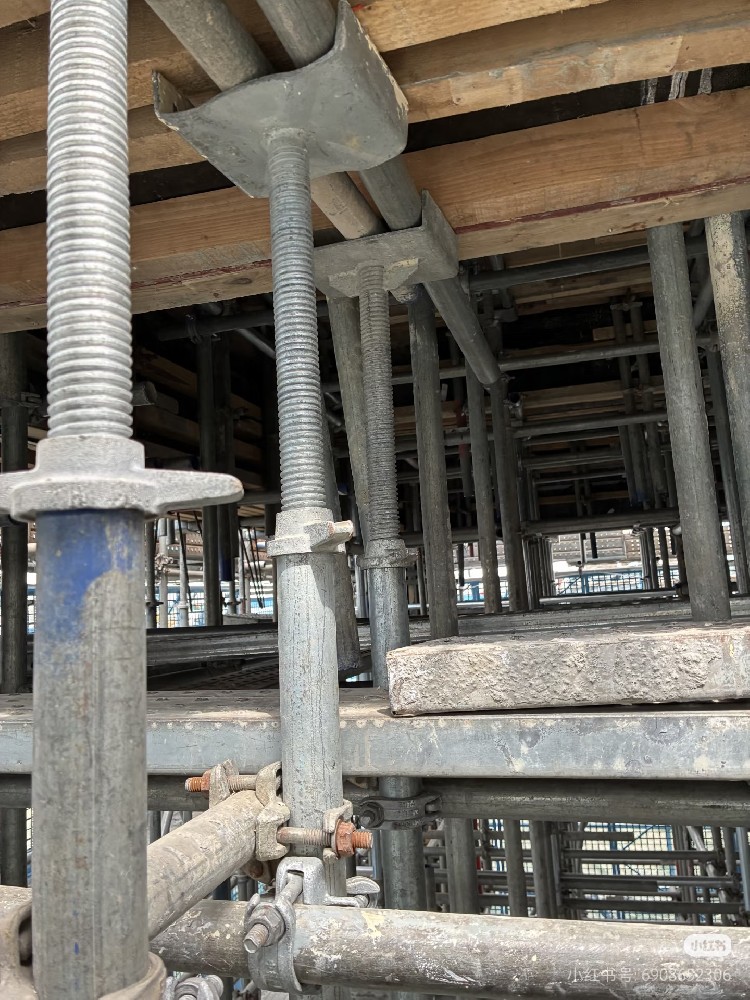
Construction preparation requirements: The bent frame installation shall be carried out progressively from one end of the beam to the other in both vertical and horizontal directions simultaneously to avoid support frame instability. All supporting rods, top braces and base braces must be inspected and qualified before use. Any deformed, thread-slipping, cracked or severely rusted top braces are prohibited from being put into construction. Base plates shall be laid and hardened on soft foundation areas to prevent uneven settlement of the support frame.
On-site installation requirements: During the erection of the support frame, the verticality of vertical poles and the levelness of horizontal poles shall be strictly controlled. The verticality deviation of the entire frame shall not exceed h/500 (h refers to the height of the vertical pole), with a maximum deviation of no more than 20mm. All top braces of the support frame shall be tightly propped one by one to ensure uniform stress on all vertical poles. Meanwhile, the telescopic specifications shall be strictly implemented: the insertion length of the screw rod into the vertical pole shall be no less than 150mm, the extension length of the screw rod shall be controlled within the standard limit, and the meshing number of screw threads shall be no less than 5 turns. This ensures firm engagement and uniform stress, and eliminates illegal operations such as virtual support, looseness and eccentric stress.
After construction, comprehensive acceptance and inspection shall be conducted to check the tightness, verticality and exposed thread length of all top braces, so as to ensure the overall uniform stress and stability of the support frame. Special personnel shall be arranged for on-site monitoring during concrete pouring to discover and rectify frame deformation and looseness in a timely manner. The top braces and support frame can only be disassembled in sequence after the concrete pouring is completed and the strength reaches the standard. Early formwork removal and illegal disassembly are strictly forbidden, so as to fully guarantee the structural safety and construction quality of the construction site.